Dutch real estate or Cyprus real estate?
Why more investors are reallocating their wealth (and why that makes sense)
For many people, real estate never started as an investment. It started as security.
A home. Something tangible. Something that still stands when everything else changes.
For years, that story worked. Especially in the Netherlands. If you started early, paid down debt and held on, you did well.
But somewhere along the way, real estate slowly changed character. Not in value. But in meaning.
And that is exactly where the difference between Dutch real estate and Cyprus real estate begins.
When property stops creating calm and starts demanding attention
What I often hear from investors is not anger. No panic. No “I need to get out of here”.
What I hear is something else:
Doubt.
Not about the bricks. But about the framework around them.
Rules that keep changing. Taxes that drift away from reality. A system that increasingly seems to say: ownership must “contribute”, regardless of what the asset actually does.
You do not feel that immediately in euros. You feel it in how often you have to think about it.
And anything that keeps taking energy eventually becomes a burden.
The Dutch starting point: calculating with assumptions
Take a simple, realistic investment.
A property with a value of EUR 350,000.
In the Netherlands, once a property is not your primary residence, it can fall under box 3. That means the system does not look at what you actually earn, but what you are assumed to earn.
- Assumed return on other assets: 6.00% (2026)
- Tax-free allowance: EUR 59,357 per person
- Taxable return: EUR 17,439
- Annual tax at 36%: approximately EUR 6,300
Whether you rent it out. Whether you have vacancy. Whether you have costs.
The model is detached from reality.
For many investors this is not a moral debate, but a signal: this is not investment logic, this is policy logic.
Cyprus starts from a different premise
Cyprus does not treat real estate as a potential annual tax source. It treats it as capital.
You see that immediately in the structure:
- No annual wealth tax
- No assumed return model
- No box 3 style framework
Tax follows activity.
You pay:
- if you rent out, on actual rental income
- if you sell, on actual profit
That may sound like a detail, but it changes everything. It makes real estate predictable again.
And predictability matters more to investors than maximum growth.
What EUR 350,000 means in Cyprus in practical terms
What surprises many people is not only the tax framework. It is what you can actually buy for the same amount.
EUR 350,000 is often “just enough” in the Netherlands. In Cyprus, it is space.
In Limassol, this budget often buys a modern sea view apartment, two or three bedrooms, in a building with amenities such as a pool, gym and secure entrance. Limassol is the business and financial hub of the island. International companies, tech firms and expats are concentrated here. That shows in stable demand and consistent price support.
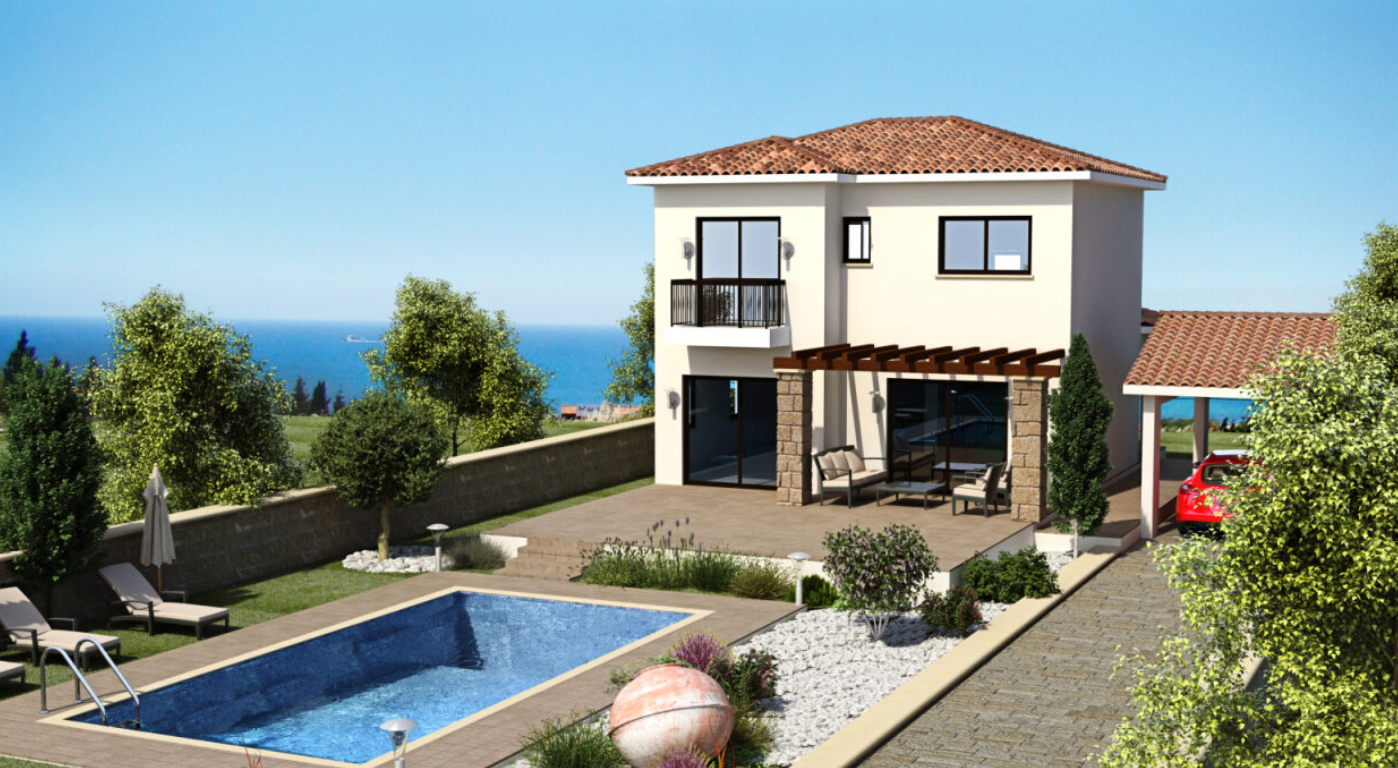
In Paphos, the same investment looks completely different. Here you are more likely to buy a villa, often with a private pool, a garden and privacy. Paphos is calmer, greener and strongly driven by long stay tourism. For investors that means long rental seasons and predictable occupancy.
And in Larnaca, the quiet growth market, this budget often buys a modern penthouse with a large terrace and sea views. Larnaca combines a lower entry level with strong price growth and direct proximity to the airport. For many investors this is currently the best balance between risk and upside.
The difference is not luxury. It is value per euro.
Yield without the noise
Let us make it concrete, without making it complicated.
Assume:
Rental income: EUR 12,000 per year
In the Netherlands:
- Box 3 tax: approximately EUR 6,300
- Net remaining: approximately EUR 5,700
- Effective tax burden: more than 50%
In Cyprus:
- Tax based on actual rent
- Effective rate: around 14%
- Net remaining: approximately EUR 10,300
Same investment. Same rent. Nearly double the net result.
And that is before price growth.
Price growth as a consequence, not a promise
Cyprus real estate has been growing on average between 4.5% and 8% per year, depending on region and segment.
That growth is not driven by subsidies or artificial incentives, but by:
- international inflow
- limited new supply
- tourism
- economic growth
That makes the market less spectacular, but more stable.
For many investors, that is exactly what they are looking for.
Why investors are shifting (without calling it that)
What you are seeing is not a flight. It is a reallocation.
Capital always moves toward places where:
- rules are clear
- returns are understandable
- risk is proportionate to reward
Cyprus does not feel “exotic” to many investors. It feels logical. EU member state. Eurozone. Legal certainty.
And above all: predictability.
Property as an anchor, not an ongoing debate
In the end, this is not about the Netherlands versus Cyprus. It is about what you want real estate to do for you.
Should it:
- demand attention
- require constant recalculation
- depend on the speed of policy changes
Or should it:
- stand calmly
- move with the market
- do what real estate is supposed to do
For a growing number of investors, Cyprus is not an exciting gamble, but a mature correction.
Finally
Most people who end up investing in Cyprus do not start with plans to buy.
They start by thinking.
About time. About calm. About what they want their wealth to do when they are not actively managing it.
Buying comes later.
Not as a leap. But as a logical consequence.